

• Home
  • About Medicon
  • Solutions
    • TPA Desk Management
    • Hospital Empanelment
    • Payment Recovery
    • Claim & Debt Management
    • Corporate Health Management
  • Consultations
    • Hospital Performance Transformation
    • Hospital Accreditation
    • Hospital Business Development
    • Medico Legal Consultation
    • Hospital Recruitment
  • Contact Us
  • +91-7777000560
  • corpoffice@medicongroupindia.com
  • prashant@medicongroupindia.com
  • Hospital Login
Hospital Login
  • Home
  • About Medicon
  • Solutions
    • TPA Desk Management
    • Hospital Empanelment
    • Payment Recovery
    • Claim & Debt Management
    • Corporate Health Management
  • Consultations
    • Hospital Performance Transformation
    • Hospital Accreditation
    • Hospital Business Development
    • Medico Legal Consultation
    • Hospital Recruitment
  • Contact Us
Linkedin Instagram Facebook

  • Home
  • About Medicon
  • Solutions
    • TPA Desk Management
    • Hospital Empanelment
    • Payment Recovery
    • Claim & Debt Management
    • Corporate Health Management
  • Consultations
    • Hospital Performance Transformation
    • Hospital Accreditation
    • Hospital Business Development
    • Medico Legal Consultation
    • Hospital Recruitment
  • Contact Us
Linkedin Instagram Facebook
Services

5 Most Common Revenue Cycle Challenges Hospitals Face (And How to Fix Them)

By Author  Published On February 23, 2026

In today’s competitive healthcare environment, hospital revenue cycle management is directly tied to a hospital’s profitability and sustainability.

For hospital owners, CFOs, and RCM managers in India, even small operational inefficiencies in the revenue cycle can result in:

  • High TPA rejection rates
  • Delayed reimbursements
  • Revenue leakage
  • Increased AR days
  • Cash flow instability

Despite investments in Hospital Management Systems (HMS), many hospitals still struggle with revenue cycle inefficiencies.

In this detailed guide, we will explore the 5 most common hospital revenue cycle management challenges, their root causes, financial impact, and proven solutions tailored for Indian hospitals.

Understanding Revenue Cycle Management in Indian Hospitals

Before diving into challenges, it is important to understand the ecosystem.

In India, hospital revenue flows from:

  • Private insurance companies
  • Third Party Administrators (TPAs)
  • Government schemes (Ayushman Bharat, CGHS, ECHS)
  • Corporate tie-ups
  • Self-pay patients

Each payer category has different documentation requirements, package structures, billing norms, and claim timelines.

Because of this complexity, hospital revenue cycle management in India requires precision, coordination, and continuous monitoring.

High Claim Denial Rates in Revenue Cycle Management

The Problem

One of the biggest challenges in hospital revenue cycle management is claim denials.

Common reasons include:

  • Incomplete documentation
  • Incorrect coding
  • Missing investigation reports
  • Package mismatches
  • Late submission
  • Policy coverage errors

Even a 7–10% denial rate can severely affect hospital cash flow.

Financial Impact

If a hospital processes ₹5 crore in monthly claims and 8% are denied:

₹40 lakh is stuck or lost every month.

Root Causes in Indian Hospitals

  • Front desk insurance verification errors
  • Lack of standardized documentation checklist
  • Poor coordination between clinical and billing teams
  • No dedicated denial management team
  • Reactive rather than proactive follow-ups

Solution: Proactive Denial Management System

Hospitals must:

✔ Implement documentation checklists
✔ Train clinical staff on insurer-specific documentation
✔ Monitor denial trends monthly
✔ Create a dedicated RCM analytics dashboard
✔ Appeal within defined turnaround time (TAT)


Denial Rate Benchmark Table

KPIIdeal BenchmarkRisk Zone
Claim Denial Rate< 5%> 8%
Clean Claim Rate> 90%< 85%
First Pass Resolution> 85%< 75%
Appeal Success Rate> 60%< 40%

Hospitals that treat denial management as a strategic function outperform competitors significantly.

Pre-Authorization Delays

The Problem

Pre-authorization delays are extremely common in Indian hospitals, especially with TPAs.

Delays result in:

  • Postponed surgeries
  • Bed blocking
  • Patient dissatisfaction
  • Escalations

For elective procedures, approval delays can create serious operational bottlenecks.

Why It Happens

  • Incomplete clinical notes
  • Incorrect estimation
  • Missing investigation reports
  • Package mismatch
  • No follow-up mechanism

Financial Impact

Delayed approvals increase:

  • Length of stay (LOS)
  • Operational costs
  • Patient dissatisfaction
  • Risk of cancellation

Solution: Streamlined Pre-Auth Protocol

Hospitals should:

✔ Create insurer-specific pre-auth templates
✔ Train TPA desk teams
✔ Submit complete documentation in first attempt
✔ Track TAT daily
✔ Use digital submission wherever possible

Strong hospital revenue cycle management starts before admission.

Revenue Leakage Due to Poor Charge Capture

Many hospitals in India operate at 60–90 AR days, which stresses working capital.

Causes

  • Slow TPA response
  • Weak follow-up process
  • Missing documents in appeal
  • Lack of aging analysis

Solution: Aggressive AR Monitoring

✔ Create AR aging reports weekly
✔ Prioritize high-value claims
✔ Escalate aged claims to senior team
✔ Assign insurer-specific RCM executives
✔ Monitor collection ratio per payer

Hospital revenue cycle management must be data-driven to control AR effectively.

Revenue Leakage Due to Poor Charge Capture

The Problem

Revenue leakage is silent but dangerous.

It happens when:

  • Services are not recorded
  • Consumables are not billed
  • Pharmacy entries are missed
  • Procedures are undercoded
  • Package components are incorrectly adjusted

Why It Happens

  • Manual entry errors
  • Lack of audit system
  • Disconnected departments
  • No reconciliation between OT, pharmacy, and billing

Financial Impact

Even 2–3% revenue leakage annually can cost crores in multi-specialty hospitals.

For a ₹50 crore hospital, 3% leakage = ₹1.5 crore loss per year.

Solution: Daily Revenue Reconciliation

✔ Implement automated charge capture
✔ Conduct random internal audits
✔ Cross-check OT notes with billing
✔ Integrate pharmacy with HMS
✔ Monitor variance reports

CFOs should conduct quarterly revenue audits to prevent unnoticed losses.

Increasing Accounts Receivable (AR) Days

The Problem

Delayed collections increase AR days.

High AR days indicate:

  • Cash flow problems
  • Inefficient follow-ups
  • Denial backlog
  • Poor coordination with TPAs
KPIHealthy Range
AR Days< 45 days
90+ Days AR< 15%
Net Collection Rate> 95%

Many hospitals in India operate at 60–90 AR days, which stresses working capital.

Causes

  • Slow TPA response
  • Weak follow-up process
  • Missing documents in appeal
  • Lack of aging analysis

Solution: Aggressive AR Monitoring

✔ Create AR aging reports weekly
✔ Prioritize high-value claims
✔ Escalate aged claims to senior team
✔ Assign insurer-specific RCM executives
✔ Monitor collection ratio per payer

Hospital revenue cycle management must be data-driven to control AR effectively.

Lack of Skilled Revenue Cycle Professionals

The Problem

Hospital revenue cycle management requires:

  • Knowledge of insurance norms
  • Coding expertise
  • Documentation understanding
  • Compliance awareness
  • Financial analytics

Many hospitals depend on undertrained staff.

Consequences

  • Frequent documentation errors
  • Poor negotiation with TPAs
  • Inconsistent billing practices
  • Audit risk

Solution: Invest in RCM Expertise

Hospitals must:

✔ Conduct periodic training
✔ Define clear SOPs
✔ Track performance KPIs
✔ Implement accountability structure
✔ Consider outsourcing complex RCM tasks

Expert-driven hospital revenue cycle management dramatically improves collections and reduces risk.

Additional Emerging Challenges in India

Beyond the top five, hospitals are also facing:

  • Government scheme compliance complexity
  • Package rate standardization pressure
  • Increasing insurance scrutiny
  • Regulatory audits
  • Digital transformation gap

Hospitals that modernize their revenue cycle infrastructure will stay ahead.

How Technology Solves Hospital Revenue Cycle Challenges

Modern RCM technology provides:

  • Real-time insurance eligibility verification
  • Automated pre-auth tracking
  • AI-based denial prediction
  • Revenue dashboards
  • Electronic document submission
  • Automated reminders

Digital transformation is no longer optional — it is a strategic advantage.

Signs Your Hospital Revenue Cycle Management Needs Immediate Attention


  • Denial rate above 8%
  • AR days above 60
  • Frequent TPA escalations
  • High revenue variance
  • Poor documentation audit scores
  • Cash flow instability

If you observe these signs, your hospital may be losing revenue silently.
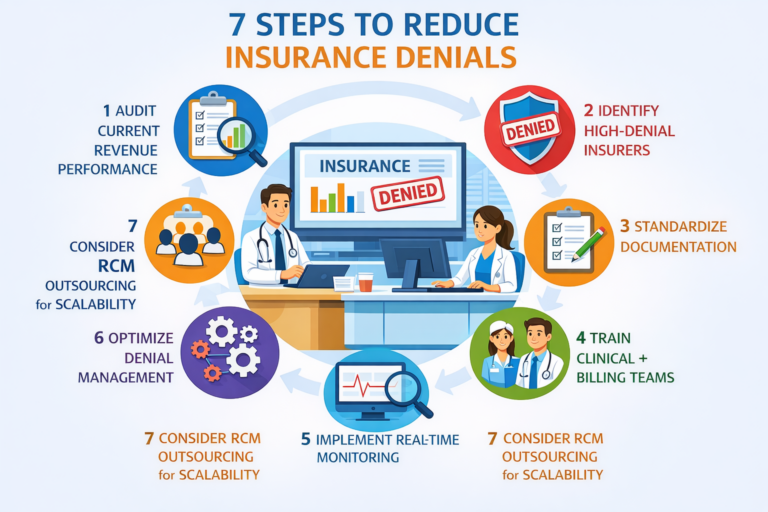
Strategic Roadmap to Strengthen Hospital Revenue Cycle Management

Strategic Roadmap to Strengthen Hospital Revenue Cycle Management

Why Experience & Expertise Matter

https://www.medicongroupindia.com/Revenue cycle management directly affects:

  • Hospital valuation
  • Investor confidence
  • Expansion capability
  • Financial sustainability


Hospitals that rely on experienced RCM professionals:

  • Reduce denials
  • Improve collection rate
  • Strengthen compliance
  • Improve financial predictability


Authority in hospital revenue cycle management is built through structured systems, analytics, and accountability.

Frequently Asked Questions (FAQs)

1. What is the biggest challenge in hospital revenue cycle management?

High claim denial rates due to documentation errors.

2. How can hospitals reduce AR days?

By proactive follow-up, denial analytics, and insurer-specific tracking.

3. Why do TPAs reject claims frequently?

Incomplete documents, coding errors, and policy mismatches.

4.What is a healthy denial rate?

Below 5%.

5. Should hospitals outsource revenue cycle management?

Outsourcing can improve efficiency, especially for mid-size and large hospitals.

Conclusion

The five biggest challenges hospitals face are:

  1. Claim denials
  2. Pre-authorization delays
  3. Revenue leakage
  4. High AR days
  5. Lack of RCM expertise

For hospital owners, CFOs, and RCM managers in India, addressing these challenges strategically can:

  • Increase revenue realization
  • Improve cash flow
  • Reduce financial risk
  • Enhance operational efficiency

Hospitals that treat revenue cycle management as a strategic priority — rather than a back-office function — achieve sustainable growth.
CTA

Image of hospital revenue cycle management
What Is Hospital Revenue Cycle Management? A Complete Guide
Previous Article

Registered Office

Medi Consultants Private Limited

270, Udyog Vihar, Phase-2, Sector 20, Gurugram, Haryana-122002

Mobile: +91-7777000560
Corporate Office

Medicon Group

270, Udyog Vihar, Phase-2, Sector 20, Gurugram, Haryana-122002

Mob: +91-7777000560

Sales and Support

Interested in our solutions? Contact our sales representatives at corpoffice@medicongroupindia.com or prashant@medicongroupindia.com

FAQ

Locate us:

Linkedin Instagram Facebook

@Medicon Group. All Rights Reserved.