RCM vs In-House Billing is a critical decision for Indian hospitals managing a growing volume of insurance-based and cashless patients. With evolving TPA rules, frequent documentation updates, and longer settlement cycles, hospital revenue management has become more complex than ever.
One strategic question hospital administrators often face is:
Should billing be handled internally, or is outsourcing to a Revenue Cycle Management (RCM) partner a better option?
This comparison explains RCM vs in-house billing from a practical, India-specific hospital operations perspective.
In-house billing refers to managing patient billing, insurance claims, and collections using the hospital’s internal administrative team.
Patient billing and invoicing
Claim submission to TPAs and insurers
Basic follow-ups on pending claims
Discharge billing coordination
While this approach offers direct operational control, it heavily depends on staff expertise, consistency, and availability.
Revenue Cycle Management (RCM) is an end-to-end financial process that manages the complete patient revenue journey—from registration and insurance verification to final settlement and denial recovery.
Professional RCM providers use:
Trained insurance and billing specialists
Standardized workflows aligned with Indian TPAs
Technology-driven claim tracking and audits
This structured approach helps hospitals reduce revenue leakage and improve cash flow predictability.
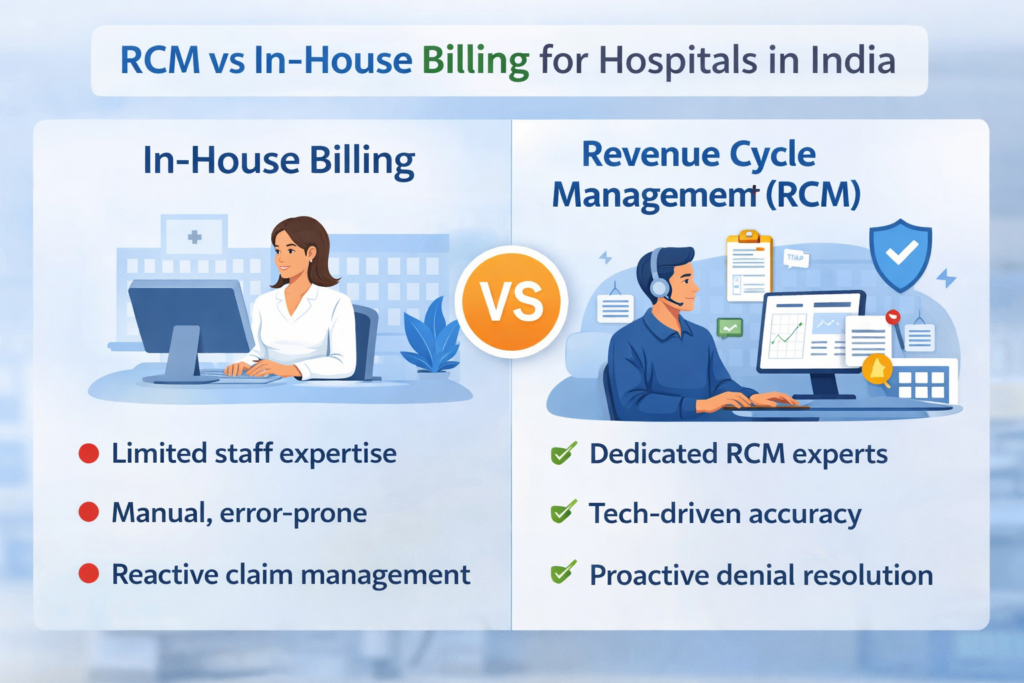
| Area | In-House Billing | Revenue Cycle Management (RCM) |
|---|---|---|
| Expertise | Limited to internal staff | Dedicated RCM & insurance specialists |
| Claim Accuracy | Error-prone | Multi-level accuracy checks |
| TPA Coordination | Often delayed | Proactive and tracked |
| Technology | Mostly manual | Tech-enabled dashboards |
| Denial Management | Reactive | Structured recovery process |
| Scalability | Difficult during growth | Easily scalable |
| Revenue Visibility | Limited | High and transparent |
Based on common hospital operational patterns, in-house billing often faces:
High staff turnover
Limited awareness of changing TPA rules
Missed submission and follow-up timelines
Weak denial tracking and recovery
Increased claim rejections and underpayments
Over time, these gaps lead to revenue leakage and delayed cash inflow.
Although in-house billing may appear less expensive initially, hidden costs include:
Hiring and training skilled billing staff
Salary and attrition overheads
Revenue loss from errors and missed follow-ups
Delayed settlements impacting cash flow
RCM services focus on maximizing net collections, making them cost-effective in the long run.
In-house billing can work for:
Small clinics with minimal insurance volume
Facilities treating mostly cash-paying patients
However, as insurance dependency grows, internal teams often struggle to scale efficiently.
RCM services are better suited for:
Small and mid-sized hospitals
Multi-specialty facilities
Hospitals with high cashless patient volume
Organizations facing frequent claim rejections
An integrated TPA Desk Management function strengthens Revenue Cycle Management Service outcomes by:
Speeding up cashless approvals
Improving documentation accuracy
Reducing settlement delays
Medicon Group combines RCM and TPA Desk Management Services to ensure end-to-end revenue control.
Medicon Group provides hospital-focused Revenue Cycle Management Service designed around Indian insurance and TPA workflows.
Experienced insurance and billing professionals
Technology-enabled discrepancy checks
Reduced claim rejections
Faster settlements and structured follow-ups
Integrated TPA desk support
Medicon works as a long-term revenue partner, not just a service provider.
For most Indian hospitals, Revenue Cycle Management is a more sustainable and reliable option than in-house billing.
RCM delivers better accuracy, faster settlements, and predictable revenue—allowing hospitals to focus on patient care rather than financial uncertainty.
📞 Looking to Improve Hospital Revenue and Reduce Claim Delays?
Partner with Medicon Group for expert RCM and TPA Desk Management Services.
👉 Connect with our team today to build a stronger, more reliable revenue system.
Medi Consultants Private Limited
270, Udyog Vihar, Phase-2, Sector 20, Gurugram, Haryana-122002
Mobile: +91-7777000560