
Revenue Cycle Management (RCM) is the structured financial framework that healthcare providers use to manage revenue generation from the moment a patient schedules an appointment until the provider receives full payment for services rendered.
It connects clinical operations with financial performance by ensuring that every service delivered is accurately recorded, coded, billed, submitted to payers, and reimbursed without unnecessary delays or revenue loss.
In today’s healthcare environment, RCM is not just about billing — it is about financial sustainability, compliance, operational efficiency, and long-term growth.
Every patient interaction creates both a clinical record and a financial transaction. Revenue Cycle Management ensures that this financial transaction moves smoothly through multiple checkpoints without breakdowns.
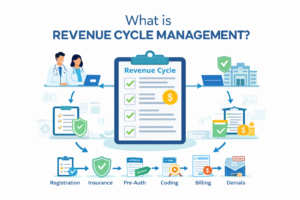
The process typically includes:
Patient onboarding
Insurance validation
Medical documentation
Coding and charge capture
Claim submission
Payment processing
Denial resolution
Reporting and reconciliation
If any stage fails, reimbursement is delayed or lost.
Healthcare reimbursement has become increasingly complex due to:
Multiple payer systems
Evolving regulatory requirements
Value-based care models
Increasing patient financial responsibility
Detailed coding standards
Without a structured RCM framework, providers may experience:
Frequent claim rejections
Growing Accounts Receivable (AR)
Cash flow disruptions
Compliance penalties
Administrative overload
A well-managed revenue cycle protects the financial health of healthcare organizations and ensures steady operational funding.
Revenue Cycle Management can be broken down into three interconnected phases.
This stage begins before care delivery.
Scheduling appointments
Collecting demographic data
Verifying insurance eligibility
Confirming coverage benefits
Obtaining prior authorizations
Estimating patient responsibility
Strong front-end controls prevent downstream billing issues.
Key Insight: Most denials originate from errors made during patient registration.
This phase occurs during patient treatment.
Accurate clinical documentation
Charge capture
Procedure coding (CPT, ICD-10)
Compliance checks
Real-time billing updates
Clear and complete documentation ensures that services are translated into correct billable claims.
Even minor coding inaccuracies can result in underpayment or audits.
This stage determines how efficiently revenue is collected.
Claim preparation and electronic submission
Payment posting
Accounts receivable monitoring
Denial identification and appeals
Patient balance collection
Financial reporting
Proactive follow-up and structured denial management significantly shorten the reimbursement cycle.
An effective Revenue Cycle Management strategy includes:
Standardized workflows
Clean claim submission processes
Timely payer follow-ups
Performance tracking dashboards
Regulatory compliance monitoring
Clear accountability structure
Consistency across departments is essential for financial efficiency.
Healthcare organizations rely on consistent revenue inflow to manage:
Salaries and payroll
Equipment procurement
Infrastructure expansion
Technology upgrades
Clinical investments
A streamlined RCM process improves:
Clean claim rate
Collection speed
Denial recovery
Net revenue realization
Organizations with optimized revenue cycles experience stronger financial predictability.
Successful healthcare providers regularly monitor financial performance metrics such as:
Clean Claim Rate
Denial Percentage
Days in Accounts Receivable
Net Collection Rate
First Pass Resolution Rate
Cost to Collect
Data-driven insights allow leadership teams to identify inefficiencies before they impact profitability.
Digital transformation is reshaping revenue operations.
Modern RCM systems leverage:
Automated eligibility verification
AI-powered claim scrubbing
Predictive denial analytics
Robotic process automation (RPA)
Integrated Hospital Information Systems (HIS)
Real-time financial dashboards
Automation reduces manual intervention, speeds up processing, and improves accuracy.
Healthcare providers without structured RCM systems often encounter:
Incomplete patient records
Missing documentation
Delayed coding
Inconsistent claim follow-ups
Poor communication between departments
Limited financial reporting visibility
Over time, these issues can significantly reduce profit margins.
Know more about revenue cycle management : What is Revenue Cycle Management?
Many providers evaluate whether to manage revenue operations internally or outsource to specialists.
Access to certified billing professionals
Lower staffing costs
Scalable operations
Advanced reporting tools
Improved denial management
Stronger compliance oversight
The right partner can transform revenue operations into a growth engine rather than a cost center.+
revenue cycle management
Financial transparency directly influences patient trust.
An optimized RCM process enables:
Clear billing statements
Upfront cost estimation
Flexible payment options
Faster insurance approvals
Reduced billing disputes
When billing is transparent and predictable, patient satisfaction improves.
Healthcare finance is evolving rapidly. Emerging trends include:
Real-time claim adjudication
Value-based reimbursement models
Integrated patient payment platforms
AI-driven revenue forecasting
End-to-end digital billing ecosystems
Healthcare organizations that invest in structured and technology-driven revenue systems will remain financially resilient in the coming years.
It includes all financial processes from patient scheduling to final payment collection and reconciliation.
It ensures accurate billing, faster reimbursement, compliance adherence, and improved cash flow stability.
Claim denials due to incorrect documentation or insurance verification errors.
On average, 30–45 days depending on payer processing timelines and claim accuracy.
Yes. Even small practices improve profitability and operational efficiency with structured billing systems.
Revenue Cycle Management is the financial backbone of any healthcare organization. It ensures that clinical excellence is supported by strong financial operations.
By implementing standardized workflows, leveraging advanced technology, monitoring key metrics, and optimizing every stage of the revenue process, healthcare providers can achieve:
Reduced denials
Faster reimbursements
Greater revenue visibility
Improved patient satisfaction
Long-term financial stability
In modern healthcare, a strong revenue cycle is not optional — it is essential for sustainable growth.