
Revenue Cycle Management (RCM) is the complete financial process healthcare providers use to track patient care from appointment scheduling to final payment collection. Professional revenue cycle management services ensure that every consultation, diagnostic procedure, treatment, and medical service is properly documented, coded, billed, and reimbursed accurately without delays or revenue leakage.
In simple terms, RCM manages the entire lifecycle of healthcare revenue — starting from patient registration and insurance verification to claim submission, payment posting, denial management, and account reconciliation. A well-structured medical billing and revenue system protects healthcare organizations from financial instability while allowing providers to focus on delivering quality patient care.
👉 For complete healthcare financial solutions, visit our homepage:
https://www.medicongroupindia.com/
Healthcare reimbursement today is highly complex. Providers must navigate:
Private insurance payers
Government programs like Medicare & Medicaid
Regulatory compliance requirements
Value-based care models
Increasing patient financial responsibility
Without a structured billing and revenue workflow, organizations often experience:
High claim denial rates
Increased Days in Accounts Receivable (AR)
Revenue leakage
Coding errors
Compliance risks
Patient dissatisfaction
An optimized financial cycle ensures stability, transparency, and predictable cash flow.
According to the Healthcare Financial Management Association (HFMA), inefficient billing processes can cost healthcare providers millions annually in lost revenue.
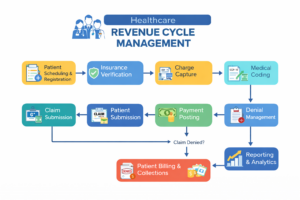
The revenue cycle can be divided into three major phases:
This stage happens before patient care begins.
Key Activities:
Appointment scheduling
Patient registration
Insurance eligibility verification
Benefits validation
Prior authorization
Financial counseling
Errors at this stage often lead to claim denials later.
This occurs while care is delivered.
Includes:
Charge capture
Clinical documentation
CPT and ICD-10 coding
Compliance audits
Accurate documentation directly impacts reimbursement success.
For coding standards, refer to the official CMS documentation:
This phase determines how quickly revenue enters the organization.
Processes include:
Claim generation
Electronic claim submission
Payment posting
AR follow-up
Denial management
Patient billing
Reporting and analytics
Strong follow-up systems significantly reduce outstanding balances.
| Component | Description | Why It Matters |
|---|---|---|
| Patient Registration | Collect demographic & insurance data | Prevents rejections |
| Eligibility Verification | Confirms coverage | Reduces denials |
| Prior Authorization | Payer approval | Avoids claim rejection |
| Charge Capture | Record Services | Ensures full billing |
| Medical Coding | Assign standardized codes | Compliance & accuracy |
| Claims Submission | Send to payer | Initiates payment |
| Payment Posting | Record payments | Revenue tracking |
| Denial Management | Correct rejected claim | Revenue recovery |
| Patient Billing | Collect patient balance | Improves cash flow |
| Reporting & Analytics | Monitor KPIs | Strategic decisions |
Healthy cash flow is essential for:
Payroll
Equipment upgrades
Facility expansion
Technology investments
Specialized billing partners help organizations by:
Increasing clean claim rates
Reducing denial percentages
Shortening reimbursement cycles
Improving patient payment collection
Enhancing payer communication
Reducing administrative burden
| KPI | Ideal Benchmark |
|---|---|
| Clean Claim Rate | 95% or higher |
| Days in AR | Below 40 days |
| Denial Rate | Less than 5% |
| Net Collection Rate | 95%+ |
| First Pass Resolution | 90%+ |
Organizations lacking proper systems often face:
Incomplete patient data
Coding inaccuracies
Late claim submission
Poor denial tracking
Compliance violations
Data security risks
Over time, these issues compound and significantly impact profitability.
Modern revenue operations rely heavily on:
Artificial Intelligence for claim scrubbing
Robotic Process Automation
Real-time eligibility tools
Predictive denial analytics
Cloud-based billing systems
Automation reduces manual errors and increases operational speed.
Many healthcare providers choose to outsource their financial workflows to expert teams.
Benefits include:
Lower operational costs
Access to certified coders
Reduced staffing burden
Better denial recovery
Scalable solutions
Improved compliance
This allows physicians to focus more on patient care rather than administrative tasks.
A well-managed financial process also improves patient satisfaction:
Transparent billing statements
Clear payment plans
Faster insurance processing
Reduced billing disputes
Financial clarity builds trust between providers and patients.
The industry is shifting toward:
Value-based reimbursement
Real-time eligibility verification
AI-powered billing platforms
Predictive denial prevention
Integrated patient payment portals
Healthcare organizations adopting advanced financial systems will maintain a competitive advantage.
The primary goal is to ensure accurate and timely reimbursement for healthcare services provided.
By verifying insurance eligibility, improving documentation accuracy, and using claim scrubbing technology before submission.
No. Clinics, specialty practices, labs, ambulatory centers, and telehealth providers all rely on structured billing systems.
Typically between 30–45 days depending on payer response time and claim accuracy.
Outsourcing can improve efficiency, reduce administrative costs, and increase revenue performance.
Revenue Cycle Management is the financial backbone of healthcare organizations. A structured approach to billing, coding, and claims processing ensures stability, compliance, and predictable revenue growth. By leveraging technology, monitoring performance metrics, and partnering with experienced professionals, healthcare providers can strengthen their financial foundation while focusing on delivering high-quality patient care.